|
Global Orders, 3D Printing in QuanzhouTime:2025-04-07
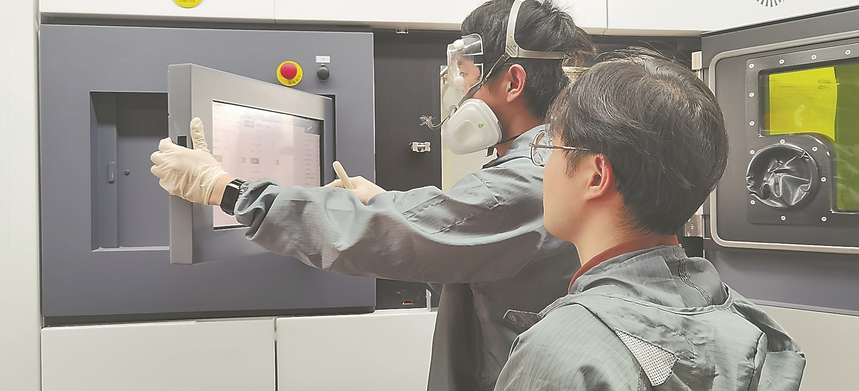
Zhongke Fengyang technicians are adjusting new equipment. Inside the enclosed printing chamber, metal powder is spread evenly. Multiple laser beams move rapidly following preset programs. Where the laser spots shine, the powder is instantly sintered into solid parts at a high temperature of 1,500℃. A single laser can sinter 2.5 kilograms of metal powder per day.Layers of powder are applied repeatedly to guarantee printing precision and quality. The operating screen shows that the shoe mold stands 60.5 millimeters high with a layer thickness of 0.03 millimeters. It consists of 2017 layers in total, among which 1529 layers have been completed. "This is an order from Germany. Based on the data imported into the equipment, a set of shoe molds can be printed in 32 hours, while the traditional manufacturing process takes at least 15 days," said Zhu Yaosheng, Chairman of Zhongke Fengyang (Fujian) Technology Co., Ltd. Rows of 3D printers stand in the production workshop of Zhongke Fengyang, located at the CITIC Heavy Industries Intelligent Equipment Industrial Base in Quanzhou. This site is home to one of the Typical Application Scenarios for Additive Manufacturing released by the Ministry of Industry and Information Technology in 2023: the project of Innovative Design of Lightweight Structure and Intelligent Production for Metal Shoe Molds. "Currently, China's 3D printing technology ranks among the world's leading levels. We have realized the domestic production of lasers, metal powders, equipment and supporting industrial software. Seizing the policy dividends for developing new productive forces and supporting the private economy, we are building the world's largest 3D printing base for metal shoe molds in Quanzhou," Zhu Yaosheng introduced.The company has kicked off its Series A financing and secured an investment of 20 million yuan from the Fujian Specialized, Refined, Differential and Innovative Enterprise Fund managed by Industrial Securities Capital. The traditional manufacturing of shoe sole molds involves complicated procedures including wooden mold making, silicone mold replication, gypsum sintering, etching and metal mold casting, resulting in long production cycles and high labor costs. Also known as additive manufacturing, 3D printing creates physical objects by fusing materials layer by layer. Based on digital models, it uses bondable materials such as powdered metal or plastic, combined with laser melting, to produce solid products.China mastered metal 3D printing technology in 2016 and applied it to the military and aerospace sectors. In the same year, Zhu Yaosheng, a professional manager with nearly a decade of experience in the traditional shoe mold industry, founded Zhongke Fengyang. The company partnered with the Quanzhou Equipment Manufacturing Research Center of Haixi Institutes, Chinese Academy of Sciences, to conduct technical verification on metal 3D printing including industrial simulation.After two years of research and development, under the same operating conditions of pressure and temperature, the 3D-printed metal shoe molds maintain the same service life. Meanwhile, metal material consumption is cut by 20% and printing time is reduced by 30%. This marks the successful application of metal 3D printing technology in the shoe mold industry. "At present, we have 52 printing units and rank as the world leader in 3D printing for metal shoe molds. We have produced over 15,000 sets of shoe molds. Our annual output value soared from more than 2 million yuan before 2020 to over 65 million yuan last year. We are building a new factory in Jinjiang, where the number of devices will rise to 100 by the end of the year, doubling our annual output value."Pointing at the logo display on the exhibition hall wall featuring Li-Ning, Xtep, 361°, ERKE, Puma, Nike and other well-known brands, Zhu Yaosheng added, "More brands keep joining our partnership, and orders from home and abroad keep pouring in. Our order volume for the first quarter has already reached 30 million yuan." The cost of metal 3D printed shoe molds is still around 25% higher than that of those made via traditional manufacturing processes. So why does Zhongke Fengyang remain highly favored by investors and the market? "Metal 3D-printed shoe molds feature intricate internal structures that are impossible to achieve with traditional techniques. They not only boost the performance of shoe molds, but also cut the manufacturing tolerance from ±1 millimeter for conventional production down to ±0.05 millimeter," said Zhu Yaosheng, holding up a shoe mold and inviting journalists to take a closer look.The mold is covered with dense, neatly arranged tiny holes, through which its honeycomb and lattice internal structures can be clearly seen. "Steam can flow rapidly through these tens of thousands of fine holes. This shortens the molding time of shoe soles and avoids pseudo adhesion caused by uneven heating in solid molds. When our molds are used to produce the popular popcorn-style shoe soles, the risks of sole delamination, fracture and material chipping are greatly reduced." Carbon plate running shoes have won the special fondness of numerous running enthusiasts thanks to the rigid support and energy return provided by carbon fiber plates. Previously, they were made through a "sandwich-style" process: upper and lower layers of material were produced using two separate molds, then adhesive was applied and bonded together with the carbon plate to form the final sole."We adopted a modular split design for the internal structure of shoe molds, breaking down the barrier of the adhesive layer. We have developed an integrated 3D printing process that produces the sole and built-in plate in one piece, eliminating the bonding process entirely from sole production," Zhu Yaosheng said. "A carbon plate running shoe brand from Fujian has benefited greatly from this innovation, saving 5 yuan in bonding costs per sole. This particular shoe model has now sold over 6 million pairs." "With technological innovation and industrial scaling, the cost of 3D printing will keep declining. The intelligent upgrade of our front-end software also further helps cut costs and improve efficiency," Zhu Yaosheng told reporters.The company has collaborated with Fuzhou University and other domestic and overseas universities to develop supporting industrial design software. Simply by uploading a 2D drawing, the system can automatically generate a 3D model. "Powered by 3D printing technology, the whole industrial process has been restructured, allowing our staff to focus more on front-end design work." 3D printing technology has reshaped the traditional industrial chain. It enables Zhongke Fengyang to set up sample development centers across different regions while concentrating mass production in Quanzhou. At the end of last year, the company launched its first overseas development center in Vietnam. A sample printing site equipped with 12 devices will be completed there in June this year to handle local orders. Within the next three years, the company will also establish facilities in Indonesia, Italy and the United States to complete its global layout. Meanwhile, Zhongke Fengyang has rolled out a string of initiatives. It is partnering with the National Carbon Measurement Center (Fujian) and Nanping Carbon Measurement Center to build the industry's first zero-carbon demonstration factory for shoe molds. Earlier this year, the company joined hands with Fuzhou University to establish the Joint R&D Center for Intelligent 3D Technology, aiming to tackle key generic technologies and cultivate interdisciplinary talents.It also plans to set up an artificial intelligence company to develop the world's first fully intelligent production line covering the entire shoe mold manufacturing process. In addition, the company will launch the "Thousand-Machine Capacity Expansion Plan". By building a distributed 3D printing network, it will strive to achieve a daily delivery capacity of 1,000 sets of molds in the future and build a world-class smart super factory for 3D printed metal shoe molds in Quanzhou. "The global annual market size of shoe molds reaches 70 billion yuan, with Quanzhou accounting for 10% of the share. Restricted by traditional manufacturing techniques, local mold factories have long struggled to exceed an annual output value of 200 million yuan. We are confident of achieving a daily output value of 10 million yuan in the near future," said Zhu Yaosheng with full confidence. This confidence stems from the trend of domestic industrial development. The customized 3D printers jointly developed by Zhongke Fengyang and Xi'an Bright Laser Technologies (BLT), a global leader in 3D printing equipment, deliver superior performance at a much lower cost than equivalent foreign devices. Such confidence also comes from strong support from all sides. This year, the state has promoted the establishment of a large-scale venture capital guidance fund to accelerate the incubation of more unicorn and gazelle enterprises. Fujian is fully implementing the strategy to build a stronger province via the private economy in the new era, encouraging enterprises to take the lead in the in-depth integration of scientific, technological and industrial innovation. Jinjiang has set up the "Jinpin Global Expansion" headquarters to support local enterprises in exploring international markets.
|