|
|
3D Printing Consolidates the Foundation of the Footwear Industrial Chain The "Mother of Industry" Drives a Trillion-Yuan Industrial ClusterTime:2025-06-09
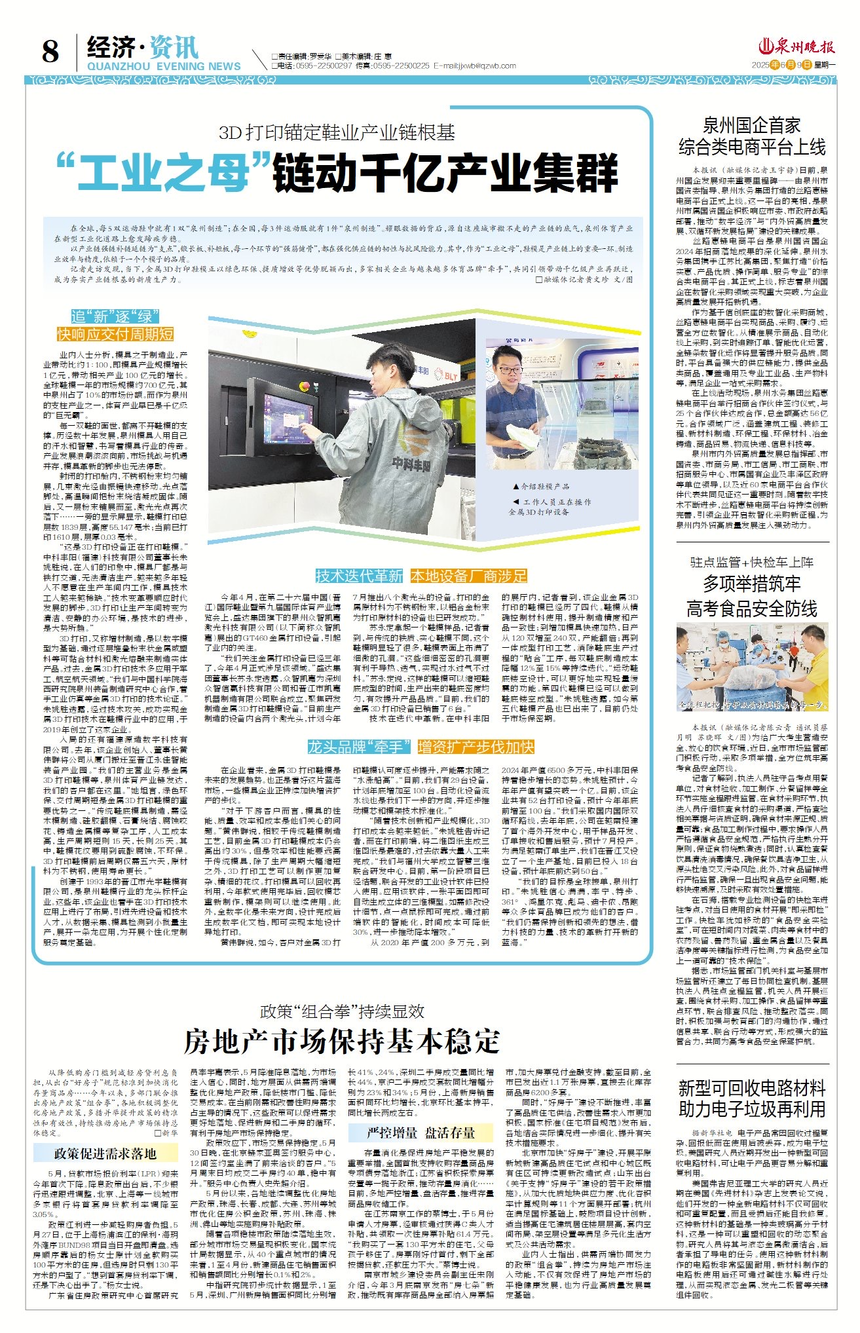
One out of every five pairs of sports shoes across the globe is manufactured in Quanzhou, and one out of every three sportswear items in China comes from this city. These striking figures speak volumes about the solid strength of the city’s deeply rooted industrial chain. Quanzhou’s sports industry is advancing rapidly and steadily along the path of new-type industrialization. Taking the efforts to strengthen, supplement and extend the industrial chain as the fulcrum, the city leverages its strengths and addresses weaknesses. Consolidating every link in the chain has continuously boosted the resilience and risk resistance of the overall supply chain. As the "mother of industry", shoe molds serve as a vital segment of the industrial ecosystem. The efficiency and precision of manufacturing are fundamentally determined by the quality of molds. During field visits, reporters learned that metal 3D printed shoe molds have emerged as a standout solution, thanks to their eco-friendly features, improved quality and higher efficiency. A growing number of local manufacturers are partnering with renowned sports brands. This collaboration is driving the trillion-yuan industrial cluster to reach new heights, and 3D printing has evolved into a new driving force that underpins the industrial chain. By Huang Wenzhen, Journalist, Quanzhou Evening News Convergence Media(Text & Photos) Pursuing Innovation and Green Development Rapid Response and Short Lead Times Industry insiders explained that molds carry an industrial driving ratio of roughly 1:100 for the manufacturing sector. To put it simply, every 100 million CNY increase in the output value of the mold industry can fuel a 10 billion CNY growth in related industries. The annual global market size of shoe molds stands at around 70 billion CNY, with Quanzhou accounting for 10% of the total share. As one of Quanzhou’s pillar industries, the local sports sector has long grown into a formidable trillion-yuan industrial giant. No pair of sports shoes can be produced without shoe molds. Over decades of development, local mold makers in Quanzhou have created remarkable achievements in the industry with diligence and ingenuity. As the industrial tide surges ahead amid intertwined market challenges and opportunities, technological innovation in mold manufacturing never stops. Inside the sealed printing chamber, stainless steel powder is spread evenly. Multiple laser beams move swiftly via galvanometer scanners. Where the laser spots land, intense heat instantly sinters the powder into solid form. A new layer of powder is then spread out, and the laser resumes its work. The adjacent display screen shows key parameters: the shoe mold is printed in a total of 1,839 layers, with an overall height of 55.147 mm. So far, 1,610 layers have been completed, with each layer measuring just 0.03 mm in thickness.
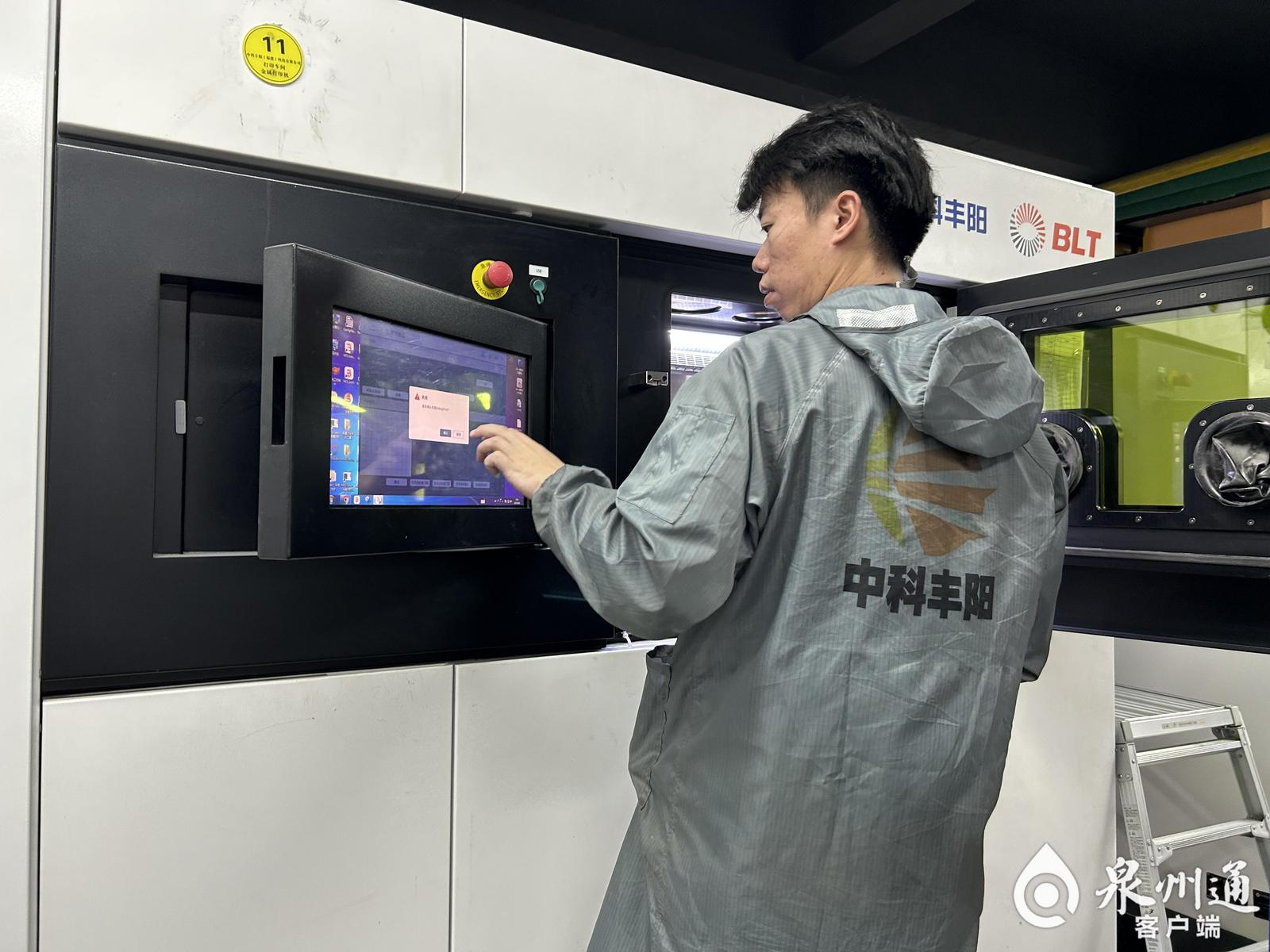
Staff are operating the metal 3D printing equipment. "This 3D printing device is producing shoe molds," said Zhu Yaosheng, Chairman of Zhongke Fengyang (Fujian) Technology Co., Ltd. Traditionally, mold factories are associated with metal processing and have long been seen as places incompatible with clean production. As a result, fewer young people are willing to work on the production floor, leading to a growing shortage of skilled mold technicians. "Technological transformation must keep pace with the times. 3D printing has turned production workshops into clean and quiet working environments. It represents technological progress and an irresistible trend." Also known as additive manufacturing, 3D printing creates physical objects based on digital models by depositing adhesive materials such as metal or plastic powder layer by layer and melting the materials with lasers. In the past, metal 3D printing technology was mostly applied in the military, aerospace and other fields. "We have partnered with Quanzhou Institute of Equipment Manufacturing, Haixi Institutes, Chinese Academy of Sciences to conduct technical demonstrations for metal 3D printing including industrial simulation," Zhu Yaosheng disclosed. After rounds of technical research and breakthroughs, the company successfully applied metal 3D printing technology to shoe mold production and was founded back in 2019. Fujian Yuanzao Digital Technology Co., Ltd. has also entered this sector. Last year, Huang Weiqun, Founder and Chairwoman of the company, relocated the business from Xiamen to Yongjia Intelligent Equipment Industrial Park in Jinjiang. "We mainly engage in the production of metal 3D-printed shoe molds. Quanzhou boasts a complete sports industrial chain, and all our clients are based here," she explained. She noted that eco-friendliness and short lead times are major strengths of metal 3D-printed shoe molds.
Introduction to Shoe Mold Products Technological Iteration & Innovation Local Equipment Manufacturers Step In At the 26th China (Jinjiang) International Footwear Expo & the 9th International Sports Industry Expo held this April, the GT460 metal 3D printing machine exhibited by Quanzhou Zhongzhi Kaijia Laser Technology Co., Ltd. (hereinafter referred to as Zhongzhi Kaijia), an affiliate of Shengda Group, drew wide attention from the industry. "We have been researching metal printing equipment for three years and officially stepped into this sector this April," said Su Yongding, Chairman of Shengda Group. Founded as a joint venture between Shenzhen Zhongzhi Xinying Technology Co., Ltd. and Jinjiang Kaijia Machinery Manufacturing Co., Ltd., Zhongzhi Kaijia focuses on the R&D and production of metal 3D printing equipment for shoe molds. "Our current models are equipped with two laser heads, and we plan to launch an 8-laser-head version this July. We adopt stainless steel powder as the raw printing material, and equipment using aluminum alloy powder has also been successfully developed." Su Yongding picked up a shoe mold sample. Reporters noticed that unlike traditional solid iron shoe molds, this sample was remarkably lighter and covered with tiny pores across its surface. "These dense pores facilitate heat conduction and ventilation, allowing water and air to pass through while blocking raw materials," Su Yongding explained. Shoe molds of this type shorten the molding time of shoe soles, deliver uniform density for finished products and effectively improve overall quality. "So far, we have sold six sets of our metal 3D printing equipment." Technology keeps evolving through continuous iteration. At the exhibition booth of Zhongke Fengyang, reporters learned that the company’s metal 3D printed shoe molds have gone through four generations of upgrades. The product iteration has achieved remarkable progress: it enables precise material control and improves manufacturing accuracy and product consistency; integrated rapid heating for molds has doubled daily output from 120 pairs to 240 pairs of shoe soles; the one-piece forming printing process eliminates the bonding procedure in sole production, cutting manufacturing costs per pair by 12% to 15%. "Hollow designs for sports shoe soles deliver superior light weight and shock absorption. Our fourth-generation shoe molds are capable of direct hollow forming for soles," Zhu Yaosheng revealed. The fifth-generation shoe mold products have already been completed and are currently kept confidential for market launch. Leading Brands Join Hands Accelerated Investment & Capacity Expansion From the perspective of enterprises, metal 3D-printed shoe molds represent the future development trend. Optimistic about this promising blue ocean market, a number of mold manufacturers are ramping up capital investment and production expansion. "Downstream clients prioritize mold performance, quality, efficiency and cost," said Huang Weiqun. Although metal 3D-printed shoe molds currently cost around 30% more than those made with traditional techniques, they deliver far superior efficiency and performance. Apart from a drastically shorter production cycle, 3D printing enables the creation of more intricate and delicate patterns. In addition, the printed molds are recyclable. After a product line is discontinued for the year, the mold cores can be recycled and remade, while mold bases remain reusable. Digitalization is also an inevitable trend going forward. Once a design is finalized into digital files, remote printing can be realized anywhere. Huang Weiqun added that market recognition for metal 3D-printed shoe molds keeps growing, driving a sharp rise in production demand. "We now have 29 sets of equipment and plan to expand the number to 100 by the end of this year. We will also build automated production lines and gradually advance the standardization of technologies for mold cores and bases." "As technology innovates and the industry scales up, the cost of 3D printing will keep declining," Zhu Yaosheng told reporters. He noted that converting 2D drawings into 3D models is the biggest challenge in the pre-printing stage, a task that once relied heavily on manual work. "We have set up an intelligent 3D joint R&D center in collaboration with Fuzhou University. The first phase of the project has been completed, and the jointly developed industrial design software is now in service. It can automatically generate 3D models from 2D drawings, and design tweaks can be done with just a few clicks. This intelligent front-end software cuts time costs by 30%, further helping us reduce expenses and boost efficiency." Zhongke Fengyang has maintained steady growth, with its output value soaring from over 2 million yuan in 2020 to more than 65 million yuan in 2024. Zhu Yaosheng estimates that the annual output value will exceed 100 million yuan this year. The company currently operates 52 printing devices, with a plan to increase the total to 100 before year-end. "We adopt a dual domestic and international development strategy. Late last year, we launched our first overseas development center in Vietnam for sample development, order processing and after-sales service, which is expected to go into operation in July. To fulfill orders from Vietnam, we have built another production base in Jinjiang, where 18 devices are already in place, and the number will rise to 50 by the end of the year." "Our goal is to take orders globally and conduct production in Quanzhou," Zhu Yaosheng said confidently. The company’s clients include numerous renowned sportswear brands such as Li-Ning, Xtep, 361°, ERKE, Puma, Decathlon and On. "We must stay committed to innovation and maintain our leading edge. Leveraging technological advances, we will explore new market opportunities." |